
WELCOME BONUS 300%
UP TO €2000 + 100
FREE SPINS
UP TO €2000 + 100
FREE SPINS
Home → Blackjack
Blackjack at Zumo Casino: Variants, Rules and Payouts
Splitting at a Live Table, Step by Step
A split at a live blackjack table lets a player divide two cards of the same value into up to four hands, each with its own stake. The rule effect for doubling after a split improves the return by about 0.14 percentage points, making it one of the more valuable choices after the split. A player with two eights against a dealer's six can split, and if the next card is a three, a double adds stake ×2 with one card only.
Resplitting aces is far less common and improves RTP by only 0.08 percentage points, a small but real difference on a 99.54% six-deck game. A split ace usually receives exactly one card each, so a resplit of aces matters only when the table rules allow it. Quantum Blackjack Plus Live from Playtech runs a bet range of 1 - 5,000 EUR, and a player using four hands at 100 EUR each is committing 400 EUR per round.
The total effect of split rules appears in the Liberal Vegas Strip set, where S17, doubling after a split, resplit and late surrender combine for a house edge of 0.28%. Against a single-deck classic game with 0.15% house edge, the difference is 0.13 percentage points. On 1,000 EUR of split and double action, that gap costs an average of 1.30 EUR more in expected loss.
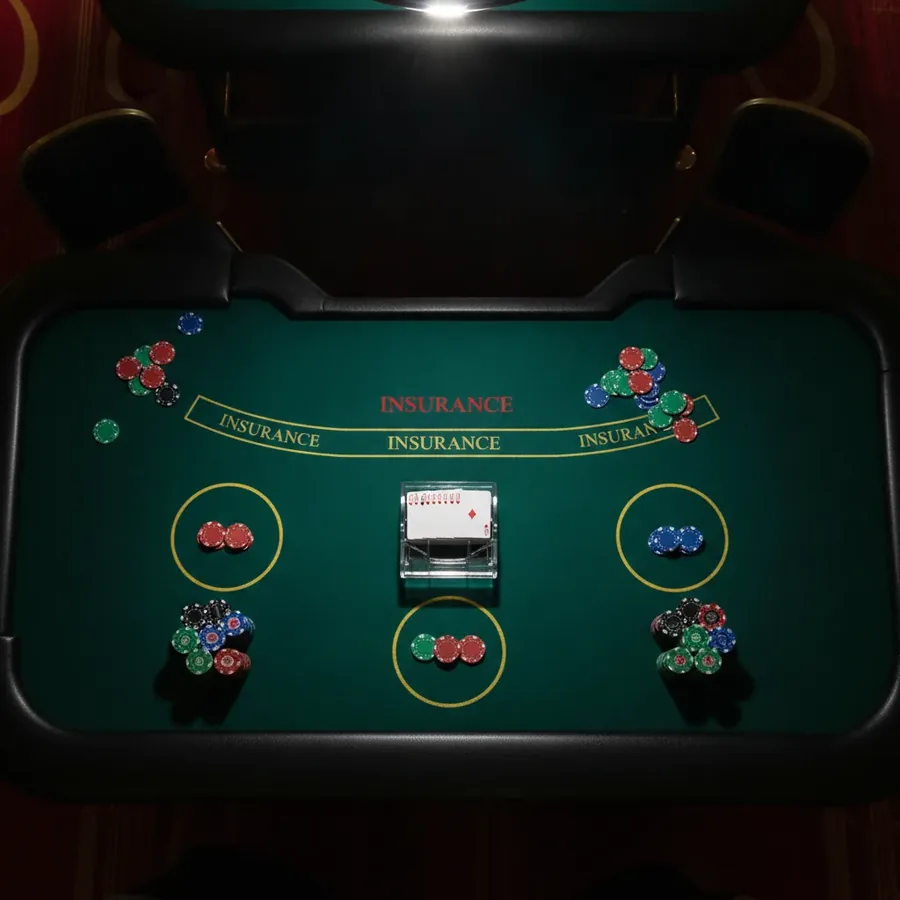
What the Hole Card Means at a Live Table
The hole card is the dealer's face-down card at a live blackjack table, and the rule about when it is checked changes how much a player can lose. Late surrender exists only after the dealer has checked for blackjack, and its rule effect improves RTP by about 0.08 percentage points. A player holding 16 against a dealer ten can surrender half the stake, losing 50% of the bet instead of risking the full amount.
Dealer hitting soft 17 is a hole-card and drawing rule that lowers RTP by 0.22 percentage points, while standing on soft 17 is the better player condition in the six-deck game with 99.54% RTP. Infinite Blackjack from Evolution offers unlimited seats and four side bets: Any Pair, 21+3, Hot 3 and Bust It, with an RTP of 99.47%. The 0.07 percentage point gap to the six-deck S17 table is the cost of that rule set.
A dealer showing an ace triggers the insurance decision before the hole card is revealed, and the 6 to 8 deck insurance side bet carries a house edge of 7.47%. Basic strategy always declines that side bet, except for a card counter at a true count of at least +3. The hole card determines whether the insurance wager pays 2:1 or is lost, and the long-run cost of taking it is far higher than any split or surrender rule effect.
The 3:2 Blackjack Payout Explained
A 3:2 blackjack payout pays 150 EUR on a 100 EUR stake, while the regular win pays 1:1. The six-deck game with S17, doubling after a split, doubling on any first two cards and a 3:2 payout reaches an RTP of 99.54% when basic strategy is used. The house edge on that table is 0.46%, so 100 EUR of staked action costs an average of 0.46 EUR over the long run.
Changing the blackjack payout from 3:2 to 6:5 adds exactly +1.39 percentage points to the casino's edge, more than any other single rule change. A blackjack on a 10 EUR bet pays 12 EUR at 6:5 instead of 15 EUR at 3:2, and the RTP falls to 98.15%. A player hitting one blackjack per hour at 100 EUR per hand loses 30 EUR in payout difference every time it happens.
The most player-friendly rule set, the Liberal Vegas Strip, keeps the 3:2 payout and combines S17, doubling after a split, resplit and late surrender for a house edge of 0.28%. Compared with the single-deck classic game at 0.15%, the difference is 0.13 percentage points. On 2,000 EUR of blackjack action, expected loss is 5.60 EUR on the Liberal Strip against 3.00 EUR on the single-deck table.
Insurance vs Even Money When You Hold Blackjack
Insurance is a separate side bet of up to 50% of the main bet when the dealer shows an ace, and it pays 2:1. The 6 to 8 deck insurance bet carries a house edge of 7.47%, which is far worse than the 0.46% of the six-deck S17 blackjack game. A player who insures a 100 EUR main bet with a 50 EUR side bet expects to lose 3.74 EUR on that side bet alone over the long run.
Even money on a player's own blackjack is the same insurance decision in disguise, paying 1:1 on the blackjack instead of 3:2. On a 100 EUR blackjack, even money pays 100 EUR while the 3:2 payout pays 150 EUR. Taking even money locks in a smaller win, and the house edge on that insurance side bet stays 7.47%, so basic strategy always declines it.
The only exception to declining insurance is a card counter at a true count of at least +3, when the remaining deck is rich in tens. With a single deck the insurance edge drops to about 5.88%, still worse than the 0.15% house edge of the single-deck classic game. Quantum Blackjack Plus Live from Playtech offers an RTP of 99.57% with optimal strategy, but that figure assumes no insurance side bets.
Six to Eight Decks in the Shoe
Fewer decks in the shoe lower the house edge, and a single deck gives about −0.48 percentage points compared with eight decks. The single-deck classic game with a 3:2 payout reaches a house edge of 0.15%, while the six-deck S17 game stands at 0.46%. A player switching from eight decks to six gains only about 0.02 percentage points, a difference too small to feel in a single session.
The six-deck table with S17, doubling after a split, doubling on any first two cards and a 3:2 payout has an RTP of 99.54%. The single-deck classic game reaches 99.85%, a gap of 0.31 percentage points. On 1,000 EUR of staked action, the six-deck player expects to lose 4.60 EUR while the single-deck player expects 1.50 EUR, assuming basic strategy is followed exactly.
Lightning Blackjack from Evolution runs a bet range of 1 - 2,500 EUR and an RTP of 99.56%, very close to the six-deck S17 table at 99.54%. Infinite Blackjack from Evolution sits at 99.47% with unlimited seats and four side bets. The shoe size matters, but the payout rule matters more: a 6:5 payout on six decks produces an RTP of 98.15%, far below any 3:2 shoe game.
Blackjack variants at a glance
| Variant | Payout | House edge | Rule | RTP |
|---|---|---|---|---|
| Blackjack 6:5 payout instead of 3:2 (6 decks) | Blackjack 6:5, win 1:1 | 1.85% | Replacing 3:2 with 6:5 adds exactly +1.39 percentage points to the casino's edge – more than any other rule change. On a €10 bet a blackjack pays €12 instead of €15. | 98.15% |
| Blackjack Single deck, classic rules, 3:2 | Blackjack 3:2, win 1:1 | 0.15% | Fewer decks = lower edge; one deck gives about −0.48 percentage points compared with 8 decks. Often offset by a 6:5 payout. | 99.85% |
| Blackjack Liberal Vegas Strip (liberal rules, 3:2) | Blackjack 3:2, win 1:1 | 0.28% | The most player-friendly rule set: S17 + DAS + resplit + late surrender. Standard deviation 1.15 | 99.72% |
| Blackjack Split / double / H17 – rule effects | Double – stake ×2 with one card; split – up to 4 hands; split aces usually get one card each. | H17 +0.22 percentage points; RSA −0.08 percentage points; DAS −0.14 percentage points | Dealer hitting soft 17 lowers RTP by 0.22 percentage points; resplitting aces improves it by 0.08 percentage points; doubling after a split improves it by about 0.14 percentage points; 6 decks instead of 8 – about 0.02 percentage points. | n/a (rule modifiers) |
| Blackjack Surrender (late surrender) – rule effect | 50% of the stake returned | −0.08 percentage points | The player gives up the hand after the dealer has checked for blackjack and loses half the stake. Improves RTP by about 0.08 percentage points. Early surrender is worth much more (up to −0.6 percentage points) but is extremely rare. | n/a (rule modifier) |
| Blackjack 6 decks, S17, DAS, DOA, 3:2 payout, basic strategy | Blackjack 3:2, regular win 1:1, insurance 2:1 | 0.46% | Dealer stands on soft 17; double down on any first two cards; doubling after a split allowed; no surrender. Basic strategy is required to reach this figure | 99.54% |
Soft vs Hard Hands in Practice
A soft hand contains an ace counted as 11 without busting, while a hard hand either has no ace or counts the ace as 1. The Liberal Vegas Strip rules show why this matters: S17 plus DAS plus resplit plus late surrender produce a house edge of 0.28%. On a 100 EUR stake, the expected loss is 0.28 EUR.
Soft totals let a player draw without immediate risk of exceeding 21, which changes basic strategy decisions at every total from 13 to 19. The 6-deck game with S17, DAS, DOA and 3:2 payout reaches an RTP of 99.54%, but only when the player follows the correct soft-hand chart. A beginner who treats soft 17 like hard 17 gives the casino an extra edge.
Late surrender adds another soft-hand option: the player may give up the hand after the dealer checks for blackjack and lose half the stake, improving RTP by about 0.08 percentage points. With early surrender worth up to −0.6 percentage points but extremely rare, the practical difference at Zumo Casino is between soft totals that can be surrendered profitably and hard totals that cannot.
Ignoring the Basic Strategy Chart: 1 Percent Wasted
A 6-deck blackjack game with S17, DAS, DOA and a 3:2 payout carries a house edge of 0.46% with basic strategy. The same game without a chart can easily drift above 1.5%, which means a 100 EUR session stake costs roughly 1.50 EUR instead of 0.46 EUR in expected loss.
The 6:5 payout variant demonstrates how fast mistakes compound: replacing 3:2 with 6:5 adds exactly +1.39 percentage points to the casino edge, moving the house edge to 1.85%. On a 10 EUR bet a blackjack pays 12 EUR instead of 15 EUR. A player who skips the chart at such a table loses both to the bad payout and to misplayed hands.
Quantum Blackjack Plus Live from Playtech shows the opposite effect of disciplined play: its RTP of 99.57% assumes optimal strategy, and every deviation from the chart cuts into that figure. With bet ranges from 1 EUR to 5,000 EUR, a single misplayed double on a 100 EUR hand costs more than the entire theoretical loss of a perfect session.
What the Peek Means When the Dealer Shows an Ace
Peek means the dealer checks for blackjack before players act on their hands. The late surrender option in the Liberal Vegas Strip rules depends on this: the player gives up the hand after the dealer has checked for blackjack and loses half the stake. The RTP improvement is about 0.08 percentage points.
Without a peek, a player who doubles against an ace risks losing the extra stake to a dealer blackjack. With peek, the dealer reveals a blackjack before the player commits. The 6-deck S17, DAS, DOA game with 3:2 payout assumes this protection, and its RTP of 99.54% includes the benefit of not losing double-down bets to hidden blackjacks.
Insurance interacts with peek at the same moment: when the dealer shows an ace, the player may take a separate side bet of up to 50% of the main bet. The RTP of Blackjack Insurance with 6–8 decks is 92.53%, and basic strategy always declines it. A player who insures at 50 EUR on a 100 EUR bet gives the casino a 7.47% edge on that side stake.
Doubling After a Split: Which Tables Allow It
DAS, or doubling after a split, improves the RTP by about 0.14 percentage points. The Liberal Vegas Strip rule set includes DAS together with S17, resplit and late surrender, producing a house edge of 0.28% and an RTP of 99.72%. A player who splits a pair and then doubles on the resulting hand keeps the full strategic value of the split.
The 6-deck game with S17, DAS, DOA and 3:2 payout also allows doubling after a split, and its RTP is 99.54%. The side rule effects show why DAS matters: resplitting aces improves the edge by 0.08 percentage points, and doubling after a split by 0.14 points. Without DAS, a player must settle for a single card or a plain hit after splitting.
The base game follows standard blackjack decisions, and DAS is the rule to confirm before sitting down. A 100 EUR stake on a split hand that allows a double uses 200 EUR total, so the table rule directly affects bankroll exposure.
A Side Bet Every Round: The Budget Lasts 30 Rounds
A side bet such as blackjack insurance carries a house edge of 7.47% and an RTP of 92.53% on six to eight decks, against 99.54% for the main blackjack game with six decks, S17, DAS, DOA and a 3:2 payout. The house edge is the average share of each stake the casino keeps, so the gap between those two figures is 7.01 percentage points.
Insurance is offered when the dealer shows an ace and can be staked at up to 50% of the main bet, paying 2:1 when the dealer holds a blackjack. On a €10 main bet that is a €5 side bet, and the 7.47% edge costs roughly €0.37 per insurance round on average, while declining it costs nothing.
Adding a €5 side bet to every €10 hand lifts the total amount at risk per round to €15, so a €150 bankroll lasts about 10 insurance rounds rather than 15 main hands. Basic strategy always declines insurance, except for card counters at a true count of at least +3; with a single deck the insurance edge is about 5.88%.
No Doubling Down on Three Cards
Doubling down is limited to any first two cards in the six-deck game with S17, DAS, DOA and a 3:2 payout, which shows an RTP of 99.54% and a house edge of 0.46%. Doubling after a split, known as DAS, improves the return by about 0.14 percentage points, and the double itself doubles the stake with one additional card.
A three-card total cannot be doubled under that rule set, and the same restriction applies in Blackjack Liberal Vegas Strip, where the RTP reaches 99.72% and the house edge is 0.28% with S17, DAS, resplit and late surrender. Late surrender lets the player give up the hand after the dealer has checked for blackjack and lose half the stake, a rule worth about 0.08 percentage points.
On a €100 stake, a double that wins at 1:1 returns €200, while the same €100 left as a single hand returns €200 as well if it wins, but the double risks twice the money for the same one-card draw. Splitting is allowed up to four hands, and split aces usually receive one card each, so no further draw is available on those hands.
Bet Two Percent of Your Bankroll per Hand
At a 2% stake, a €1,000 bankroll puts €20 into each hand, and the 0.46% house edge of the six-deck game with S17, DAS, DOA and a 3:2 payout costs about €0.09 per hand on average. That is roughly €9 per 100 hands staked at €20, against a theoretical return of 99.54% over hundreds of thousands of hands.
The same 2% rule on a €500 bankroll puts €10 on the table, and a blackjack at 3:2 pays €15, while the 6:5 payout on six decks pays only €12; the 6:5 version carries an RTP of 98.15% and a house edge of 1.85%, which is 1.39 percentage points more than 3:2, more than any other single rule change.
Blackjack Single deck with classic rules and a 3:2 payout shows the strongest figure at 99.85% RTP and a 0.15% house edge, but the 6:5 payout often replaces 3:2 there. On a €10 bet that swap cuts the blackjack return from €15 to €12, so the stake size matters less than the payout rule attached to the table.
Continuous Shuffling Machines Reshuffle After Every Round
A continuous shuffling machine returns the cards to the shoe after every round, which removes the deck penetration that card counters rely on, and the insurance side bet is the clearest example: its RTP is 92.53% and its house edge 7.47% on six to eight decks, and basic strategy always declines it except for card counters at a true count of at least +3.
With the six-deck S17, DAS, DOA, 3:2 game at 99.54% RTP and a 0.46% house edge, the machine does not alter the published return, because that figure assumes a fresh shuffle and basic strategy on every hand. The reshuffle instead removes the chance to raise a bet on a rich shoe, so the 0.46% applies to every €100 staked, or about €0.46 per €100.
Counting aside, the machine speeds up the game, and more hands per hour means the 0.46% edge is applied more often: at 100 hands per hour with €10 stakes, that is €1,000 staked and roughly €4.60 retained on average. A single deck instead of eight decks lowers the edge by about 0.48 percentage points, but only when the 3:2 payout is kept.
One Deck vs Eight Decks: The House Edge Gap
Blackjack Single deck with classic rules and a 3:2 payout shows an RTP of 99.85% and a house edge of 0.15%, while the six-deck game with S17, DAS, DOA and 3:2 shows 99.54% RTP and a 0.46% edge. One deck against eight decks is worth about 0.48 percentage points in the player's favour, which is the largest single structural difference between the two formats.
That advantage disappears if the payout drops to 6:5: the six-deck 6:5 version has 98.15% RTP and a 1.85% house edge, which is 1.70 percentage points worse than the single-deck 3:2 game and 1.39 percentage points worse than its own 3:2 counterpart. On a €10 bet a blackjack pays €12 at 6:5 and €15 at 3:2.
Deck count also interacts with other rules: H17 adds 0.22 percentage points to the edge, resplitting aces removes about 0.08, doubling after a split removes about 0.14, and moving from eight decks to six removes about 0.02. Blackjack Liberal Vegas Strip combines S17, DAS, resplit and late surrender for 99.72% RTP and a 0.28% edge.
Contact
Live - online chat
Banking









Providers












Zumo Casino 2026